
Voice + wearables
Murmur
An open intelligence layer for Omi and other AI wearables. Own the recordings, choose the models, preserve memory, and securely direct a computer or server from anywhere.
View repository Wega Labs
Beyond keyboard and mouse. Closer to human intent.
The architecture / 01
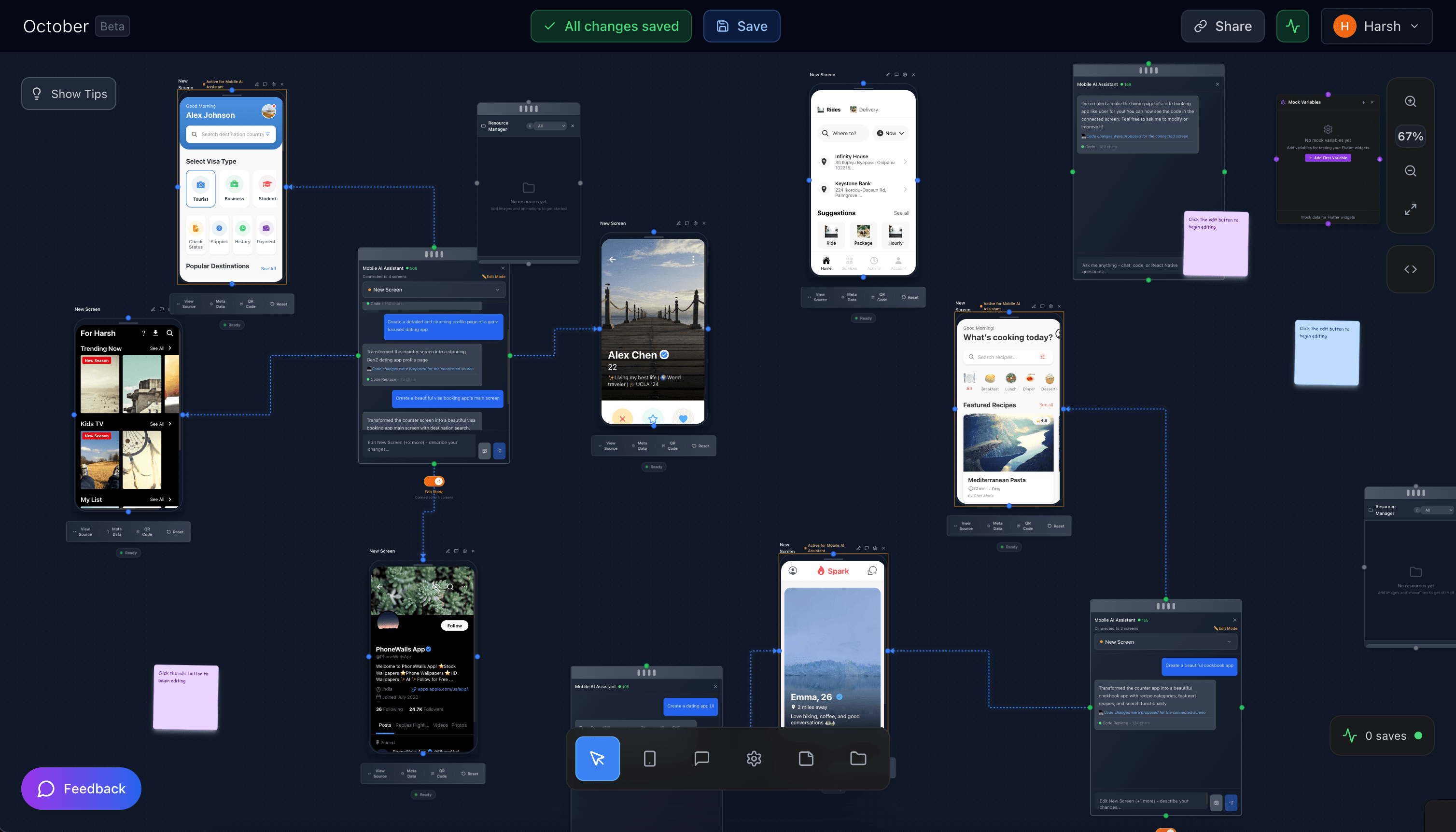
October is the shared canvas containing the agents, computers, machines, and outputs a person needs to supervise.
Murmur opens voice wearables and remote action. Fovea combines gaze with hand gestures. Noema develops deliberate biosignals into text and commands. Each project exposes a reusable interface instead of locking the modality to one product.
Each project works alone. Together, they give October new ways to understand intent.
Open source programme
Useful on their own, interoperable by design, and open under Apache 2.0.
Voice + wearables
An open intelligence layer for Omi and other AI wearables. Own the recordings, choose the models, preserve memory, and securely direct a computer or server from anywhere.
View repository
Gaze + gesture
An open visual-input engine that turns ordinary cameras into control. Look to target, select with intent, and use a hand gesture to move, drag, scroll, or manipulate.
View repository
Biosignals + text
Open infrastructure for translating deliberate EEG, EMG, EOG, and motion signals into confidence-aware text and commands—without pretending to read unrestricted thought.
View repositoryThe protocols and reference foundations stay open. Wega builds the most capable products, models, and managed experiences on top.
Authoring and selection / 02
Writing a sentence means producing every bit. A sentence carries about fifty bits.
Choosing among three candidates costs 1.6 bits. The model provides the candidates.
Reviewing, approving, and redirecting agents are selection tasks.
Where this matters
Direct tests and agents while standing beside a robot, vehicle, or electronics rig.
Supervise several machines while moving through the environment or working with both hands.
Choose the control channel that fits the person and the situation—not the desk.
Plate II / 03
The top three rows are selection. The bottom row is authoring.
Human budget1–2 bits / second
Stage 01 · Live / 04
Four candidates per step. Seven steps. One instruction out of 16,384.
Stage 01 · Live
Four choices, seven steps, two bits each. This stage tests the interaction before the sensor.
Variants A and B are ready. What should happen next?
Select a candidate to begin.
Method · log₂(4) = 2 bits per choice. Output uses Shannon’s ≈1.1 bits per character. Model-supplied bits equal output bits minus emitted bits. Time includes reading.
The baseline / 05
Type the sample to measure the authoring cost.
The authoring baseline
Type the line at your normal speed. The text stays on this page.
Typing uses ten fingers. A single deliberate signal carries one or two bits per second.
Method · bit/s = characters per second × bits per character. Naive: log₂(27) ≈ 4.75. Entropy: Shannon’s ≈1.1. Rungs are typical estimates, not measurements.
Our thesis / 06
Code-modulated visual evoked potentials, or c-VEP, assign a visual code to each target. Attention to a target produces a matching response in the visual cortex.
Compare the recorded signal with each code to identify the selected target.
Attention is the input.
Information rate / 07
Imagined movement, extensive per-user training
Visible voluntary movement, fatigues quickly
Occipital electrodes, precise stimulus timing
Published c-VEP results report 0.77–0.84 accuracy across subjects and 0.98 for the best performer. These are literature results, not ours.
What we build
October is the software we build and ship — a workspace for supervising agents, computers, and machines. Murmur, Fovea, Noema, model-ranked selection, and attention research expand how you control it.
If an engineer is beside a robot, car, electronics rig, or factory machine, walking back to a laptop to type “Agent 4, rerun this test” is absurd. Speak from across the room, look at the agent to focus it, or use a gesture to control the canvas.
Wega Labs is the lab. October is the flagship product. Murmur, Fovea, and Noema are open infrastructure that any product can use.
For companies, October becomes the interface layer that lets people supervise complex agent and machine operations without sitting in front of one keyboard.
Product path
A spatial canvas for agents, screens, terminals, and previews—with Otto voice control.
Murmur, Fovea, and Noema are public Apache-2.0 projects for voice wearables, gaze + gesture, and biosignal-to-text.
Attend to a canvas object to focus it, then choose an action through gaze, gesture, biosignals, or model-ranked selection.
Artifact control / 08
The artifactual component of the EEG signal is significantly more informative than brain activity with respect to classification accuracy — consistent across different feature extraction methods and classification pipelines.Artifacts in EEG-Based BCI Therapies: Friend or Foe? · Sensors 22(1):96
Jaw, eye, and neck activity can be more predictive than brain signal. Many BCI studies do not report artifact controls.
Artifacts can help a communication interface. They cannot support a claim about brain state.
We test every neural result against a muscular explanation.
Programme / 09
Each stage has a public pass condition. Stages 01 and 02 test interaction and display timing before neural hardware.
A laptop camera detects deliberate blinks. Natural blinks last 100–150 ms; deliberate blinks exceed 400 ms. Each deliberate blink commits a model-ranked candidate.
The interface reports bits, selections, and effective words per minute.
95% detection with under one false positive per minute, across three faces in two lighting conditions.
A photodiode measures when each flash reaches the screen. A 60 Hz display updates every 16.7 ms and can add frame jitter.
This separates display error from biological variance.
Recover a known modulation sequence from the photodiode alone, with no participant involved, plus a published jitter distribution for our display.
Occipital electrodes record responses to coded canvas objects. Each object uses a circular shift of one base sequence.
80% accuracy across four targets within two seconds. The programme begins with four targets; published forty-target results remain literature references, not the Stage 03 baseline.
Increase target count, reduce calibration, and improve the visual design.
Scheduling starts after Stage 03 passes.
Defined after Stage 03 clears its gate.
Research standard / 10
We name the signal, input method, and model contribution.
We report target count and time per selection beside accuracy.
We test every neural result against a muscular explanation. Mixed signals remain labelled as mixed.
Prior results keep their citation, apparatus, participants, and conditions.
We publish each gate, result, and dataset.
Test the selection interface before public release.